





[ad_1]
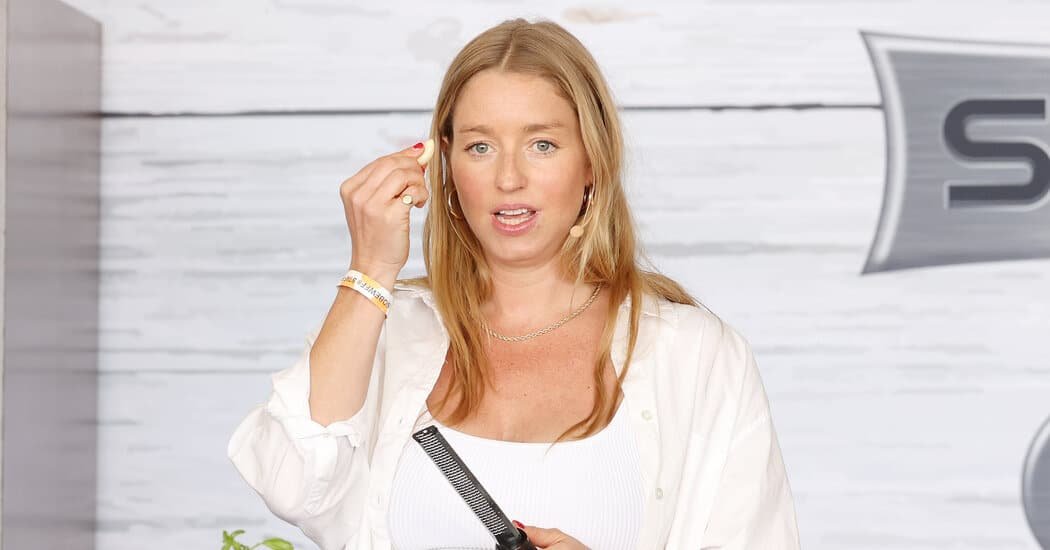
An ethereal-looking image of Molly Baz, the cookbook author, with her pregnant belly exposed and her breasts covered with not much more than a rhinestone bikini top and two oatmeal cookies, floated high above Times Square.
It was a digital billboard, measuring 45 feet tall, for Baz’s lactation cookies — a recipe to stimulate milk production that she developed in partnership with the breastfeeding start-up Swehl. The tag line read: “Just Add Milk.”
The ad was scheduled to be up for a week, from Monday through Mother’s Day, playing for the first minute of every hour. But three days later, on Thursday, it was pulled out of the sign’s rotation.
Brex, a company that helped Swehl get the ad up on a billboard powered by Clear Channel, was told by a Clear Channel representative that the ad violated “guidelines on acceptable content,” according to an email reviewed by The New York Times. Brex later clarified that the original artwork was “flagged for review” and that it was replaced with another image from the campaign. The new creative does not feature Ms. Baz’s breasts as prominently; she is perched on a kitchen counter top in jeans and a crop top, eating one of her cookies.
The billboard, however, is in a location that often runs underwear ads by brands like Skims and Michael Kors. It appeared to be another example of what some experts have said is a double standard that persists in the advertising world: a sexualized breast is acceptable, a nursing or lactating one is not.
“As the day progressed yesterday, certainly Betsy and I became really incensed,” said Elizabeth Myer, who co-founded Swehl with Betsy Riley, who pointed out that breastfeeding in public was not legal in all 50 states until 2018. “This really highlights how we’re still dealing with systemic shame of our bodies and breasts at the highest levels.”
Clear Channel did not respond to requests for comment.
Advertising has long had an ambivalent relationship with women’s health content. It was not until 2017 that an ad for period products was allowed to run using red liquid, as opposed to what has been deemed the more palatable blue. In 2020, an ad by the mother and baby care brand Frida that realistically depicted the pain of postpartum recovery was rejected from airing during the Oscars. And online content related to women’s health or breastfeeding is often censored on social media, as was the case for the baby care company Tommee Tippee, which ran a campaign titled “Boob Life” for its breast pumps, depicting a montage of realistic breastfeeding vignettes and breasts.
Ads being rejected, however, can prove to be great publicity, thanks to the reach of social media. In 2015, for example, the period underwear brand Thinx claimed that New York City’s subway system would reject ads that featured a suggestive pink grapefruit or a runny egg yolk, driving a heated conversation on X (then Twitter) and in the news media. The ads eventually went up. Tommee Tippee, too, was able to bring back its Boob Life campaign on certain social media sites because of the backlash those platforms received for initially rejecting the ad.
The reaction to Ms. Baz’s cookie campaign “absolutely knocked our socks off,” Ms. Myer said. When it was announced on social media, Swehl saw a 500 percent increase in traffic to their website, drawing in 40,000 new users. The brand, which was founded last year and hosts a library of free educational breastfeeding videos online and sells breastfeeding accessories, also runs community events, virtually and in person, helping parents to connect with one another, and provides hospitals with latching kits.
“I do a fair amount of partnerships with different brands,” Ms. Baz said. “What I see often is that my organic content always outperforms branded partnerships just because people know they’re being served an ad.” But “this campaign was completely different — it outperformed much of my own organic content.”
The day the billboard was replaced happened to be Ms. Baz’s birthday, and the representatives from Swehl tried to keep the news from her for as long as they could. “I am not going to let it rain on my parade,” she said. “I just see this as an opportunity and not as something that’s going to like squash us down.”
So far, as with most things online, the response to the ad campaign primarily on Instagram has been varied. Some see it as “epic” or “iconic.” One person wondered, “Which one is tasteless, the cookie or the photo??” Another pointed out the stark hypocrisy of the situation: “For all the pearl clutchers, if we can handle Jeremy Allen White in his chonies on billboards all over NYC,” they wrote, “I think the city can survive this paen to Mother Bountiful. Right on.”
Ms. Myer, who will be traveling to New York from Los Angeles on Saturday for work events, had planned to come with her mother to celebrate Mother’s Day and to see Ms. Baz’s larger-than-life image in all of its Times Square glory. Now, she plans to “just sleep in.”
Source link