





[ad_1]
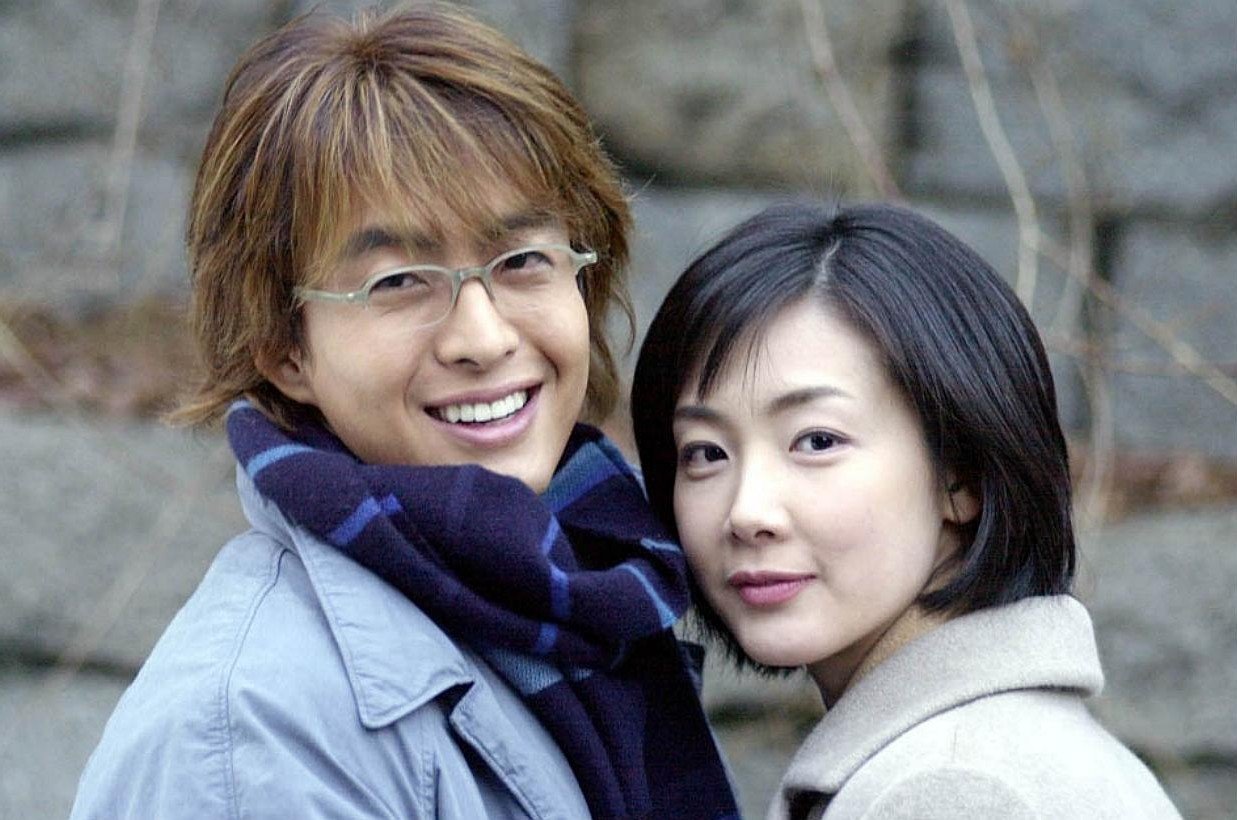
Bae Yong-joon (left) and Choi Ji-woo (right) in a still from ‘Winter Sonata.’ Photo: courtesy of KBS2.
Winter Sonata (2002) is more than just a timeless love story—it’s a landmark in K-drama history. The second instalment of director Yoon Seok-ho’s classic tetralogy, the Endless Love drama series, Winter Sonata draws you in with its powerful performances, evocative score, and emotional storytelling. It’s a heartwarming reflection on how different forms of love—between partners, friends, and family—shapes the course of our lives.
Without giving away too much (in case you haven’t seen the drama), Winter Sonata opens with Kang Joon-sang (Bae Yong-joon) moving to a Korean hamlet. Although he’s a model student, deep down, he carries the weight of grief and complex family dynamics. One day, while riding the bus, his classmate Jeong Yoo-jin (Choi Ji-woo) nods off on his shoulder. In the weeks that follow, they begin to grow closer, slowly falling in love. But it all ends abruptly when Joon-sang suffers amnesia after surviving a near-fatal car crash.
In the aftermath, Joon-sang relocates to the United States to start a new life under the name Lee Min-hyung. A decade later, Min-hyung, now working as an architect, is unable to remember his past in Korea. When he returns, Yoo-jin spots him on the street and decides to break off her engagement, unaware that Min-hyung is seeing Oh Chae-rin (Park Sol-mi), her former rival. Amid the drama, Yoo-jin’s interior design firm gets an assignment from Min-hyung’s architecture firm, stirring up old emotions and complications.
A significant part of Winter Sonata‘s appeal is its universal themes of love and loss, coupled with the poignant portrayal of longing and nostalgia. It transcends cultural borders and is considered iconic in the world of melodramatic and romantic Korean dramas.
Bae Yong-joon and Choi Ji-woo’s collaboration in Winter Sonata represents a powerful alliance that culminates in one of the most beautiful romances in the K-drama universe. Choi delights in vividly capturing the essence of Yoo-jin, while Bae’s portrayal lends significant weight to her role. Their love story is a welcome reminder: the ending, or perhaps a new beginning, of your story depends on you, and living in the present is what it takes to be happy.
The drama’s moody OST further echoes its themes, adding to the beauty of its plot and visuals. The music conveys pulsating emotions, giving a fresh layer of intensity to an already all-consuming story in a way that captures the protagonists’ experiences. For instance, Ryu’s rendition of “My Memory” is a soulful ballad that perfectly conveys the unyielding spirit of love and the quest to rediscover it after a heartbreak—an ideal fit for the emotional moment when Yoo-jin spots Joon-sang, presumed dead for years, and is flooded with memories that fuel her desire to reconnect.
With its massive impact on fostering Korean culture and attracting travelers to the idyllic shooting location of Nami Island, Winter Sonata was instrumental in propelling the second wave of the Hallyu Wave, expanding its reach into new territories including Japan, the Philippines, Malaysia, Nepal, and Indonesia.
The series became wildly popular in Japan, creating a “Yonsama” craze, with fans adding the suffix “sama,” typically reserved for Japanese nobility, to Bae Yong-joon’s name. In 2009, an anime version of Winter Sonata premiered in Japan, with the director Ahn Jae-hoon and writer Kim Hyeong-wan bringing back the original Korean cast members, including Bae and Choi, to voice their respective roles.
The drama’s breakthrough in Japan opened the door for K-dramas to become a more widespread phenomenon outside of Korea and helped establish them as a cultural export.
[ad_2]Source link